Kitchen and Cabinet Design for Scottsdale Golf Homes: Designers, Cabinetry and Desert-Ready Choices (2026)
- •In a Scottsdale golf home, the kitchen is the room guests gather in after a round, so plan it around entertaining, views and how many cooks use it at once.
- •In Arizona, cabinets and countertops fall under the Registrar of Contractors R-60 Finish Carpentry classification, and a B-3 remodeling contractor must subcontract electrical, plumbing and mechanical work. Check every license before you sign.
- •KCMA A161.1 certified cabinets have passed 14 third-party tests, including a 600-pound load test. Ask whether a line is certified, or how a custom shop builds and warrants its boxes.
- •Scottsdale does not treat its water for hardness. The city reports roughly 16 to 25 grains per gallon depending on the area, which affects faucets, dishwashers, ice makers and stone finishes.
- •A 2025 national survey put upscale major kitchen remodels above $160,000 on average. Verify any figure for your home with licensed professionals.
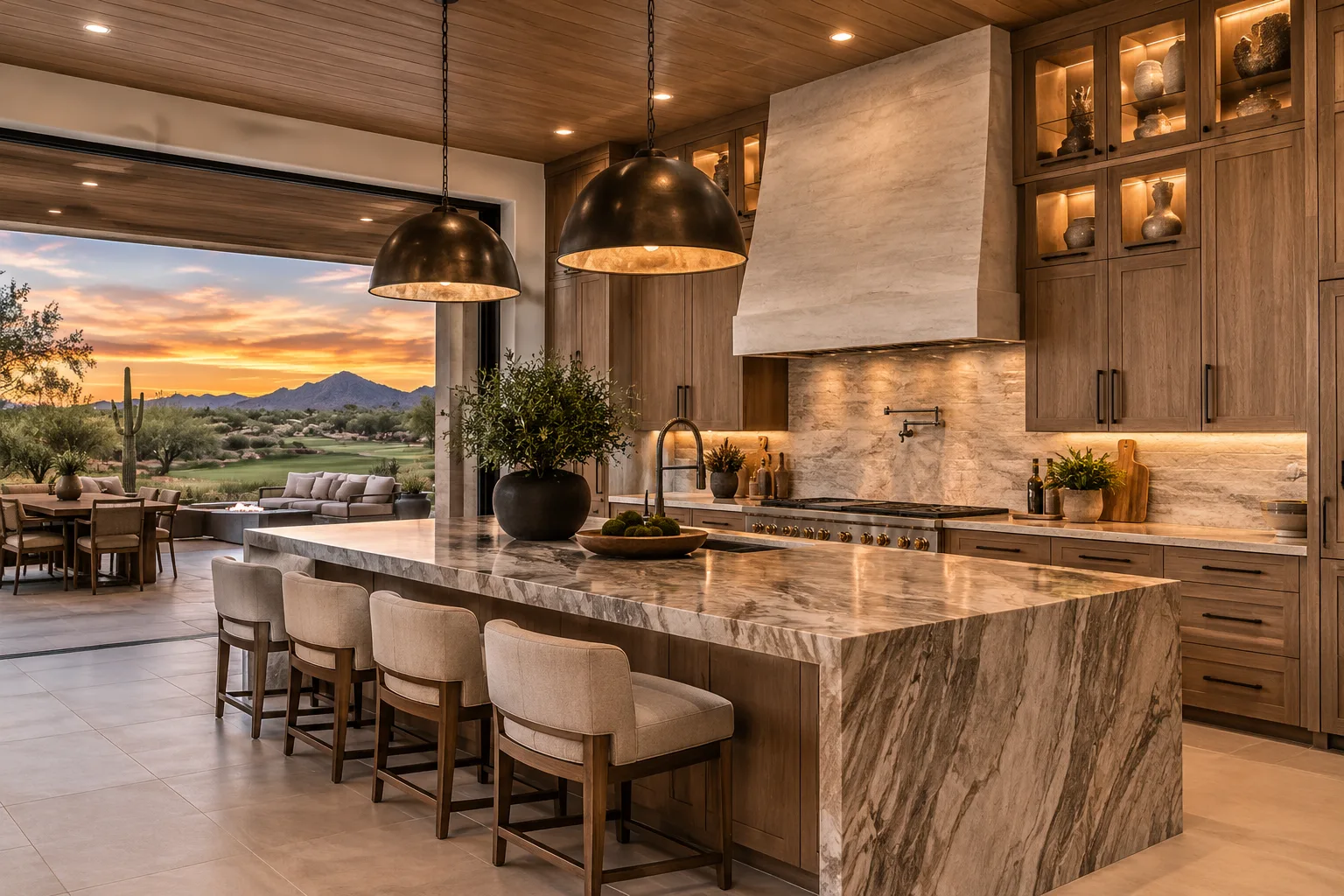
In a Scottsdale golf home, the kitchen rarely works alone. It opens to the great room, looks out over a fairway or the McDowell Mountains, and connects to a patio where the group from the morning tee time ends up by late afternoon. It is the most used room in the house and, for most owners, the most expensive one to change.
This guide covers how to plan a kitchen for a golf home in Scottsdale, Paradise Valley, Fountain Hills, Cave Creek and Carefree: who designs it, who can legally build it, how to judge cabinetry and countertops, and which desert conditions belong in the brief before anyone draws a line.
Important: This is general editorial information, not legal, financial or construction advice. Licensing rules, codes, community guidelines and costs change. Verify every requirement and every figure for your project with the relevant agency and a licensed professional.
Start with how the house is used
Before you look at a single door style, we suggest answering a few questions with everyone who uses the kitchen:
- Who cooks, and how many at once? A kitchen for one cook and a kitchen where a couple, a private chef and a caterer share space are different rooms.
- How do you entertain? A tournament-week gathering for thirty needs staging space, a second dishwasher and somewhere for guests to stand that is out of the work zone.
- Full-time or seasonal? Part-year owners often want systems that shut down cleanly for summer and start up easily in October.
- Where are the views? In many golf homes the best window is behind the sink or the range. Cabinet layout should protect that view, not block it.
If you hire a private chef for dinners at home, invite them into the planning. Our private chef guide covers what chefs need from a working kitchen.
Who designs a kitchen
There are three common paths, and many good projects combine them.
A dedicated kitchen designer. These specialists focus on layout, cabinetry, appliance specifications and the mechanics of how a kitchen works. The National Kitchen & Bath Association (NKBA) offers a Certified Kitchen & Bath Designer (CKBD) credential. NKBA says candidates must be members in good standing, meet education and experience requirements, and pass a fundamentals exam plus a portfolio evaluation. A credential is a useful signal, but a portfolio of finished kitchens matters more.
An interior designer. An interior designer connects the kitchen to the rest of the home: finishes, lighting, furniture in the adjoining rooms and the overall feel. Arizona does not license interior designers the way it licenses contractors, so references and finished work are the real test. Our interior designer guide covers fees and agreements.
The cabinet showroom or custom shop. Many cabinet companies include design with a cabinet order. This can be efficient, but the design is usually built around that company’s product. Ask who owns the drawings if you decide to buy elsewhere.
Whichever path you take, ask to see kitchens the designer completed at least a few years ago. In the desert, how a kitchen ages tells you more than how it photographs on day one.
Who can legally build it
Arizona licenses contractors through the Arizona Registrar of Contractors (ROC). As our remodeling guide explains, work of $1,000 or more, or any job that needs a building permit, generally requires a licensed contractor.
For kitchens, the residential classifications in Arizona’s administrative code that come up most often are:
- B-3, General Remodeling and Repair. Can run the remodel, but electrical, plumbing and mechanical work must be subcontracted to licensed trades.
- R-60, Finish Carpentry. The scope includes cabinets and countertops, along with trim and wood flooring.
- R-48, Ceramic, Plastic and Metal Tile. Includes stone tile such as marble or slate, common on backsplashes.
- R-11, Electrical and R-37, Plumbing. For new circuits, lighting, fixtures and gas or water lines.
- R-63, Appliances. Covers appliance installation, but the classification does not allow running gas, electrical or plumbing lines.
Look up each license on the ROC website. Confirm it is active, that the classification fits the work, and that the business name matches your contract. A kitchen remodel that moves walls, plumbing or gas lines will usually need a City of Scottsdale permit, or a permit from the town where you live.
Cabinetry: what separates good from great
Cabinets typically drive a large share of a kitchen budget, and they are the part you touch every day. Here is what we would look at.
Construction
Framed or frameless. Framed cabinets have a face frame around the box opening. Frameless, often called European style, gives slightly more interior access and a cleaner, contemporary line. Both can be excellent. The choice is mostly about style and how the doors sit.
Box material and joinery. Ask what the boxes are made of, how the joints are assembled, and what the back and bottom panels are. Ask to see a sample box, not just a door.
Hardware. Drawer glides and hinges are where cabinets wear first. Ask about weight ratings and the warranty on hardware specifically.
Certification
The Kitchen Cabinet Manufacturers Association (KCMA) runs a certification program under the ANSI/KCMA A161.1 performance standard. KCMA says certified cabinets have passed 14 third-party tests, including a 600-pound load test, along with tests for drawer and door endurance and joint strength. KCMA offers a "Find a Certified Company" search on its website.
Many high-end custom shops do not certify every piece, and that is not a red flag on its own. With a custom shop, ask how they build their boxes, what finish they use, and what their written warranty covers.
Finishes in a dry climate
Scottsdale’s low humidity and strong sun are hard on wood. Solid wood moves as moisture changes, and finishes near west- and south-facing glass can fade or yellow. Ask your designer and cabinetmaker:
- How their finish holds up in direct desert sun
- Whether they recommend window film or shading for cabinets near large glass
- How solid wood doors and panels are built to handle movement
Countertops and the silica question
Natural stone such as granite, quartzite and marble, engineered stone, porcelain slabs and solid surface all appear in Scottsdale kitchens. Each has trade-offs in heat resistance, etching, staining and maintenance. Marble, for example, can etch from acids such as citrus and wine, which matters in a kitchen used for entertaining.
There is one issue every buyer should know about. OSHA has issued a hazard alert on engineered stone, which it says "often contains large amounts of silica." Cutting and finishing it can create high airborne levels of silica dust, which is linked to silicosis, a disease OSHA describes as incurable and progressive. The risk is to fabrication workers, not to the family using the finished counter. OSHA requires employers to use engineering and work practice controls to keep exposure at or below the legal limit.
If you choose engineered stone, ask your fabricator how they control dust in their shop and on site. A professional fabricator will have a clear answer.
Hard water belongs in the design brief
This is the Scottsdale-specific detail most kitchen plans miss. The City of Scottsdale reports water hardness of about:
- 22 to 25 grains per gallon south of Indian School Road
- 20 to 22 grains per gallon between Indian School Road and Chaparral Road
- 16 to 18 grains per gallon north of Chaparral Road
The city does not treat for hardness. It notes that scale can clog faucets and aerators and reduce the efficiency of some appliances, and it leaves spots on dishes and glasses. Homes in Paradise Valley, Fountain Hills, Cave Creek and Carefree are served by different water providers, so check your own provider’s report.
For a kitchen, that means a few practical questions:
- Water treatment. Many owners add a softener, a filtration system or both. Plan where the equipment and drain will go before cabinets are drawn.
- Fixtures. Ask how faucet finishes and cartridges handle mineral buildup.
- Appliances. Dishwashers, ice makers, steam ovens and refrigerator water lines all deal with scale. Check manufacturer guidance on water quality and warranty terms.
- Surfaces. Some stone and dark finishes show water spots more than others.
Layout for entertaining
Golf households tend to entertain in groups, often on short notice after a round. A few layout ideas that come up again and again:
- Separate the work zone from the gathering zone. An island with seating on one side and prep on the other keeps guests close without putting them in the cook’s path.
- Leave real aisle space. NKBA planning guidelines call for wider work aisles than many older homes have, especially when more than one person cooks.
- Consider a scullery or back kitchen. A secondary prep and cleanup space hides dishes and catering work during an event.
- Plan beverage storage. A beverage center or bar near the great room keeps traffic out of the main kitchen. For serious collections, a dedicated wine room is its own project.
- Connect to the patio. Many Scottsdale homes have large sliding or pocket doors to an outdoor kitchen. Our outdoor entertaining guide covers permits and planning for that side.
Community design review
Interior kitchen work usually needs less community review than exterior work. But a kitchen project that changes windows, adds an exterior vent, moves a gas line to an outdoor kitchen or brings in large deliveries may involve your HOA. Many gated golf communities also regulate contractor hours, access and parking. Read your community’s guidelines and ask management before work begins.
Budgeting a kitchen
Kitchen costs vary widely with size, cabinetry, appliances, stone and what is behind the walls. For context only, the 2025 Cost vs. Value report from the Journal of Light Construction put the national average for an upscale major kitchen remodel above $160,000, a midrange major remodel in the $80,000 range, and a minor midrange update under $30,000. Luxury kitchens in Scottsdale golf communities can land well above national averages, depending on scope.
These are national averages, not quotes. Verify every figure for your home with licensed professionals.
A few habits that keep budgets honest:
- Get at least two or three detailed bids for the same scope.
- Compare cabinet, appliance and stone allowances line by line.
- Ask about lead times for cabinets, appliances and slabs before you set a schedule.
- Hold a contingency for surprises in older homes.
- Put the payment schedule on completed milestones, not dates.
Scheduling around the season
Many part-year owners schedule kitchen work for summer while they are away. Interior work can go well in summer, but plan ahead: cabinet production and appliance deliveries can take months, and summer heat affects crews and some materials. If you want the kitchen ready for the fall golf season, start design in winter or early spring.
If you will be away during the work, agree in writing on who can approve changes, ask for regular photo updates, and coordinate contractor access with your community’s gate.
A short checklist before you sign
- A designer whose finished kitchens, in homes like yours, you have seen.
- Every contractor and subcontractor license checked on the ROC website.
- A written scope with drawings, cabinet specifications and appliance list.
- A clear answer on how cabinets are built and warrantied.
- A plan for water treatment, with space reserved for the equipment.
- Your fabricator’s answer on dust control if you choose engineered stone.
- Permits and HOA review assigned to a named person.
- Allowances, lead times and a contingency in the budget.
The bottom line
The best Scottsdale kitchens are planned around how a golf household lives: groups after a round, views worth protecting, and a desert climate that tests every finish and fixture. Hire for finished work you have seen, check every license, and put hard water in the brief from day one.
Our directory lists Preferred Partners across home services and the golf lifestyle as it grows. Until a category is filled, start with portfolio reviews, license checks and two reference calls.
Figures are illustrative ranges compiled from public sources and change with the market. Verify current pricing, dues and fees with a licensed Arizona real estate professional or directly with the club.
Keep reading